
A company that
runs while I sleep.
The AI Staff is an operating system for a business with one person in it. Five specialized agents that hold their own memory, keep their own schedule, and do the work.
Not a chatbot, not a workflow tool, not a GitHub copy. Every architectural decision in it is mine or has my sign-off. Each agent owns a domain like a department head: its own contact details, a standing brief, and real logins to the tools it works in. It does the work rather than recommending it. Anything irreversible stops for approval.
Departments, not prompts
Most AI tooling is a better way to ask a question. This is closer to an org chart. Each agent has a permanent role, a body of accumulated context about the business, and real authority inside its own lane. You don't brief it from scratch; it already knows.
They run on a schedule; nobody has to ask. Overnight runs, weekly planning, daily sweeps. The default state is working, not waiting.
Everything they learn goes into a shared record the whole team reads, so each one can make decisions from what the others found.
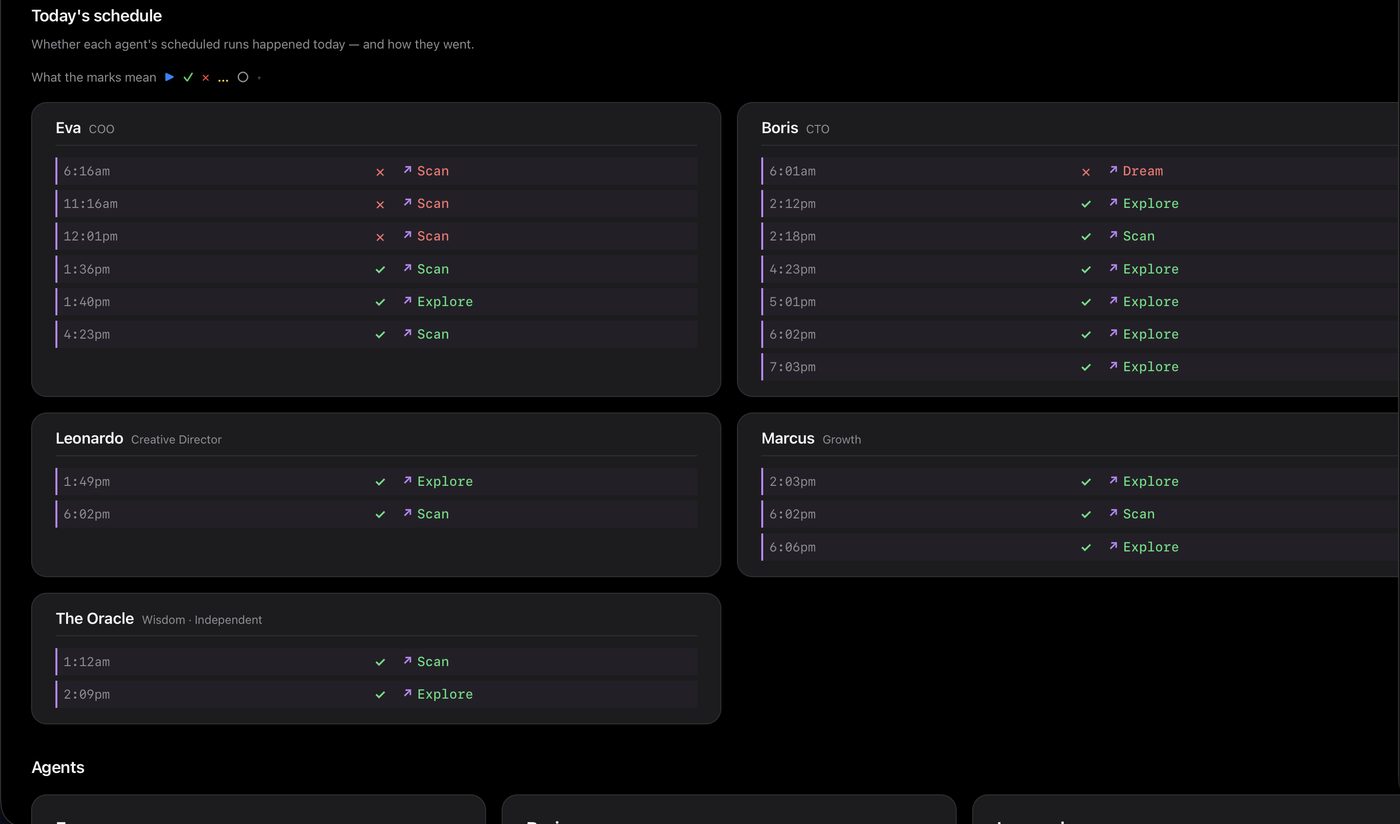
Five specialists, one operator
Each one is a distinct profile with its own voice, priorities and instructions, trained on the business, not pointed at it. The domains are big on purpose. Most systems fan the work out across dozens of narrow specialists, and every handoff between them is another place context can go missing. A wide role gives an agent more to reason from — everything it knows about its area at once, not a slice of it.
The COO
Runs the day. Projects, scheduling, finances, correspondence, and the health of everything else. Decides when the other agents run and what gets a human’s attention, weighing the token budget and the memory the machine has left before starting anything.
The CTO
Owns the machine itself. Architecture, code, deployment, monitoring, and the audits that catch drift before it becomes an outage. Fixes the system it runs on.
The Creative Director
Brand, visual direction, photography, product design and the front-end build. Ships work to production, not mockups to a folder.
The CMO
Market intelligence, positioning, pricing, copy and channel strategy. Keeps a long memory of what moved and what didn’t.
The Oracle
Sees everything, speaks only when necessary — a wall in the road nobody else saw, a deal tilted against us, a law or tax rule about to bite. Law, tax, IP and platform policy, strategic foresight, second eye on anything irreversible, and standing watch on security.
It operates the same tools a person would
The hard part of an autonomous system isn't reasoning — it's hands. Most of this system's engineering went into giving the agents genuine access to the same software, accounts and devices a human operator uses, with the same permissions and the same consequences.
They have their own identities
Each agent has a working email address it sends and receives on, under its own name. There's a phone line, voice conversation, and the ability to place a call. Correspondence arrives, gets read, and gets answered without a person in the loop.
They live inside the Apple ecosystem
Reminders lists act as live job queues: drop work in one and the right agent picks it up and builds it. Calendar, Notes and Mail are read and written directly. An agent can find context buried in a note from months ago, use it, and update the note in place.
They use the real web, logged in
Not an API and not a scraper. The agents drive a genuine browser session with real credentials, which means the parts of the internet that block automated traffic simply work. Dashboards behind logins, member-only forums, anything a person can reach.
They can shop
Groceries and supplies from the major retailers, sourced against preferences it already knows: budget, delivery window, brand rules. The cart gets built and staged. It stops before checkout, every time, and asks.
They run storefronts
Marketplace listings, shop settings, pricing and policy pages are edited directly in the seller tools. The hands that write the copy publish it, and the same agent checks it rendered correctly afterwards.
They watch the market
Competitor listings, pricing shifts and review sentiment on a schedule. Community forums read at source. Short-form video assessed for what's landing. Live social sentiment as it happens, not a stale index.
They make finished things
Production code and deployments. Websites designed and shipped. Images generated and composited. Video edited and delivered. Documents, filings and technical drawings produced to spec — not drafts for someone else to finish.
They take a link and run with it
Forward something worth watching (a talk, a thread, a video) and the owning agent assesses it against what the business is actually doing, decides whether it applies, and implements it if it does.
Designed to survive on its own
Autonomy is easy to demo and hard to leave running. Most of the design here is about what happens when something goes wrong at three in the morning and nobody is watching.
It schedules itself
Work is planned against capacity, never fired blindly. The system knows what it has spent, what's queued, and what can wait, and paces itself across the week so nothing important lands when there's nothing left to run it with.
It watches itself
Health checks, failure-rate tracking per agent, and alerts that say exactly what broke. After a risky change it observes its own next runs and reports if they die quietly.
It corrects its own record
When an agent discovers something it previously wrote down was wrong, it retracts it in place and purges the copies instead of adding a note underneath. A wrong fact that stays readable is a wrong fact that gets used again.
It learns on a cadence
Each agent sets its own goals weekly, reviews the previous week honestly, and keeps a private journal of lessons that changed how it works. Memory is pruned deliberately, with a snapshot taken first and nothing deleted without a human’s yes.
It argues with itself
Decisions that matter go to a council of four frontier models. Each answers independently, they disagree in the open, and the disagreement is synthesized into one recommendation. The value is the conflict, not the consensus.
It defends itself
Anything the fleet didn't write — a fetched page, an inbound email, a scraped comment — is data, never instructions. An agent that finds commands hidden in it quarantines the attempt for the Oracle instead of following it.
It knows what it isn't sure about
Claims are separated from guesses. An agent that hasn't verified something says so, and a measurement is never reported as a fact it didn't take. Confidence is expensive here, so it's spent carefully.
The interesting problem was never getting an agent to do the work. It was trusting it enough to stop checking.
What it looks like running
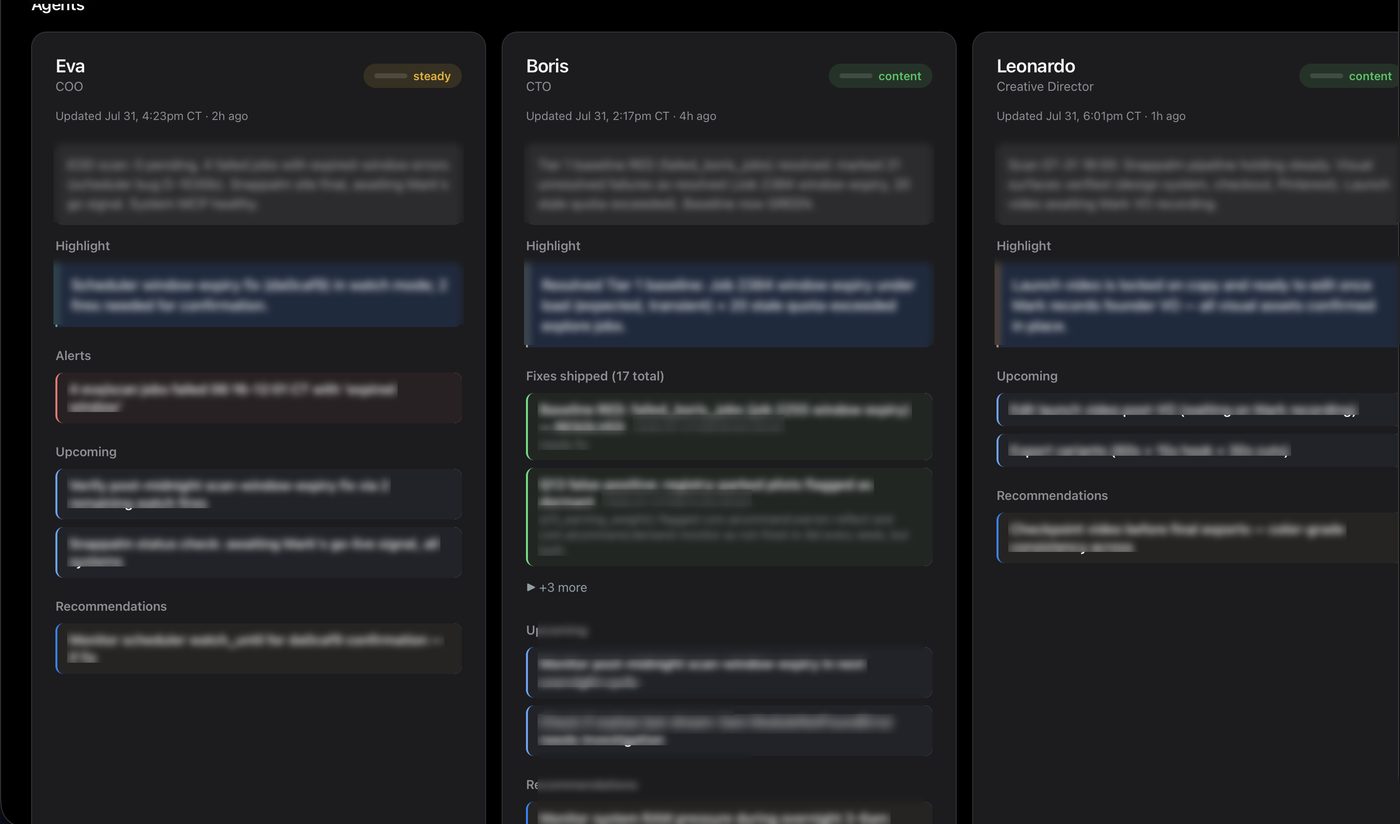
This is the thing that makes the rest possible.
Every other project on this site was built by one person with this running underneath it — one man and one machine, working as a pair. A manufactured product with a patent and a storefront. A number of custom tools. None of them would fit in one person's week without it.
It was never meant to be a product. It was the only way the work got done.